The following is the culmination of my career over the past 27 years. It is the start of a new series that will dive deeper into the industry and also how people can find relief. There is more commentary in the podcast than is written below, sometimes providing additional context.
The Manufactured Mental Health Crisis: How We Have Been Lied To
Behavioral health has remained a gray area for a long time. There has been a concerted effort in the past few decades to classify addiction and mental health issues as medical conditions.
On one hand, there is enough biological evidence of change to point to where some experts have been able to make valid arguments, while on the other there are plenty of examples where social factors and behavioral patterns are the predominant driver.
And thus, the crux of the issue that has been exploited. We’re going to take some time to dissect these theories and some research tied to them. We’re also going to follow the amount of money spent on certain parts and the results.
Just recently, the Chairman of the Subcommittee on Health Care and Financial Services of the U.S. House of Representatives Oversight Committee opened up a discussion to review mental health spending. In his opening remarks, he stated:
“We are here to examine a difficult but urgent issue: the state of mental health in this country, why it appears to be getting worse, whether the system designed to address it is working, and what we in Congress should do about it.
Over the past two decades, the United States has dramatically expanded access to mental health care.
In 2002, about 27 million adults received mental health treatment. By 2024, that number had grown to nearly 60 million.
And yet, outcomes are moving in the wrong direction.
Depression rates are at historic highs. Suicide rates have climbed back to their highest levels in decades.
By multiple measures, Americans report worse mental health today than in previous generations.
As you can see on the chart behind me, as individuals receiving mental health care increased, the rate at which they reported their mental health being excellent decreased.
That raises a fundamental question: if we are treating more people than ever before, why are we not seeing better results?
This is not just a public health concern—it is also an economic one.
A study published last week found that from 2000 through 2021, mental health and substance use disorders nominal spending grew from $40.9 billion to $139.6 billion.” 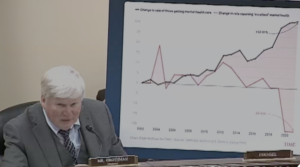
—
“On the government spending side, more than one in three Social Security Disability Insurance beneficiaries are enrolled due to mental disorders, making it one of the largest drivers of a program originally intended for those with severe physical limitations.
At the same time, many Americans are bearing these costs personally. One in ten have gone into debt to pay for mental health care.
Perhaps most concerning is what we are seeing among young people.
Rates of mental health diagnoses in children and adolescents have risen sharply, along with the use of psychiatric medications.
Antidepressant prescriptions for individuals aged 12 to 25 increased by more than 63 percent between 2016 and 2022. During that time a total of more than 221 million antidepressants were prescribed and dispensed to 18 million individuals aged 12 to 25.
Yet even as treatment has expanded, outcomes for youth continue to worsen.
In 2021, 57 percent of teen girls reported persistent feelings of sadness or hopelessness, up from 36 percent just a decade earlier.
We are intervening more, medicating more, and spending more. Yet, many of the people we are trying to help are not getting better.
There is something in this system that is not working as intended.
Let me be clear about what today’s conversation is not.
This is not an argument against mental health care, nor is it an attempt to stigmatize those seeking help.
But when a system produces outcomes like these, despite significant investment, we have a responsibility to ask hard questions.”
If they keep digging further, what they will soon discover is that the mental health crisis has been manufactured and is being perpetuated by those who profit from people being sick and staying sick.
Let’s go back a bit.
Let’s also take a look at the Bible of the mental health industry, the Diagnostic and Statistical Manual of Mental Disorders (DSM), which is now in its fifth edition. The first edition was published in 1952 and listed 106 diagnoses. It continued to grow over time. By the third edition in 1980 there were 265 diagnostic categories. In its current form, there are now 297 disorders listed. It is virtually impossible not to find at least one disorder that we all could be diagnosed with if we go through it. If you don’t believe me, you should try it for yourself.
The American Medical Association declared alcoholism a disease in 1956. Fast forward to 1997, then Director of the National Institute on Drug Abuse, Dr. Alan Leshner, declared addiction to be a chronic, relapsing brain disease that is treatable but not curable. Dr. Nora Volkow has been the Director since 2003 and has been continuing to force this theory on the nation, despite just as much evidence to the contrary – that people can and do fully recover/heal/become cured all the time and there are no social or biological markers of a disease remaining, whether or not they go to treatment.
The same theory has been pushed about other disorders, as the National Institutes of Health claims that most mental illnesses can be treated, but cannot be cured. Even when it has been years without any symptoms and when there is no biological evidence of disease.
The pharmaceutical connection cannot be ignored. Prescriptions for depression and anxiety alone have soared through the past few decades, to the point where there are tens of millions of children and adults taking them today. This, despite the research that finally admitted in 2022 that there is no conclusive evidence that depression is caused by a reduction in serotonin levels. Let’s not also forget that many ant-anxiety medications are commonly among the most abused prescription drugs – second only to pain medications. Or how about the millions of kids who are put on stimulants for an ADHD diagnosis.
Most of these disorders are originally caused by some kind of trauma – whether a single traumatic event or a series of smaller events tied together (often referred to as big Ts and little Ts). Let’s be clear – everyone experiences trauma in their lives. The difference is in how we all respond to those events. The same thing can happen to two people and they can have completely different responses.
Two of the most revered trauma experts are Peter Levine, Gabor Mate, and Bessel van der Kolk. Among many quotes, Levine shared that, “Trauma is a fact of life. It does not, however, have to be a life sentence.”
Mate famously said, “All of the diagnoses that you deal with – depression, anxiety, ADHD, bipolar illness, post traumatic stress disorder, even psychosis, are significantly rooted in trauma. They are manifestations of trauma. Therefore the diagnoses don’t explain anything. The problem in the medical world is that we diagnose somebody and we think that is the explanation. He’s behaving that way because he is psychotic. She’s behaving that way because she has ADHD. Nobody has ADHD, nobody has psychosis – these are processes within the individual. It’s not a thing that you have. This is a process that expresses your life experience. It has meaning in every single case.”
Van der Kolk wrote, “The greatest sources of our suffering are the lies we tell ourselves.”
Now, let’s take a look at some larger traumatic events that we have faced as a nation, on top of the ones we experience as individuals, just in the past 25 years or so.
The tragic events of September 11, 2001 shook the nation. Ever since we have been told to “never forget” and are reminded every year that terrorism is a constant threat.
The Great Recession from 2007 to 2009 caused financial destruction, and many people lost their savings, their homes, and their dignity.
Most recently, much of the world came to a standstill in 2020 due to the COVID pandemic, causing sever rifts and fear while forcing people into isolation.
Throughout this entire time, the 24-hour news networks have continued to push messages of fear, chaos, threats, and panic, keeping people constantly on edge and filled with repeated reminders. Fear is widely recognized as a tool used to control people, especially larger populations.
Deaths of despair began to rise sharply from 2001 onwards, as did mass shootings. Coincidentally, so has social media usage.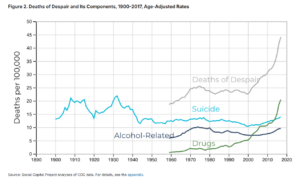
However, billionaires in tech, pharma and media weren’t the only ones capitalizing on the opportunity to profit from this formula. Venture Capital and Private Equity firms have poured billions of dollars into mental health and addiction treatment companies in recent years, and the largest health insurance companies have posted record profits, more than tripling in the past decade to over $1.7T.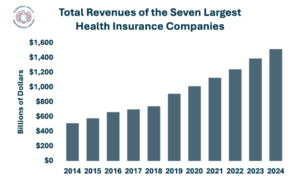
Another factor that has driven spending in behavioral health was the passage of both the addiction and mental health parity act of 2008 and also the affordable care act of 2008. These laws required more insurance coverage for behavioral health conditions while removing preexisting conditions as exemptions of coverage. On the surface, these looked like great things since it gave more access to people who could use their insurance, but it escalated quickly and providers soon found out they could make six figures from a single patient, rather easily in some cases.
It turns out that being sick is big business, especially when the type of sickness is said to have no cure and requires ongoing treatment, and when both the insurers and providers profit more the worse people are, so there is incentive to hand out more and more diagnoses – you know, from the book where we all kind find a disorder that fits us.
What happens if you want to use your insurance to talk to a therapist? They have to give you a diagnosis in order to receive payment. What happens if you go to a treatment program for more severe addiction or mental health problems? They are required by most state laws and regulatory bodies to give you a diagnosis within 24 hours.
Many people then continue to live with these new identities of the disorders and labels they’ve been given. Instead of recognizing that most conditions are in fact temporary, they’re led to believe they now have these things for life, and therefore continue to live out that script, even to the point of explaining why they can’t get unstuck in life. It’s a different kind of crutch, and they’re not even aware its causing more damage because a trusted source gave it to them.
We have been set up and lied to over and over and over again. The powers that be are routinely profiting off our constant state of heightened distress. And so the money keeps flowing – more fear pumped into society, more ads driving them into treatment, therapy and prescriptions, and more profits as a result. It’s like a slot machine that hits triple 7s every few spins.
Today there is a glimmer of hope. Fed up with the ever-increasing costs and the worsening statistics, people are starting to look at the human condition with more common sense. Physical health and mental health are part of whole person care, and when one suffers, so does the other. Thankfully, when one improves, the other improves as well.
Things like the six pillars of lifestyle medicine are catching on again: Optimal Nutrition, Physical Activity, Restorative Sleep, Stress Management, Connectedness, and Avoidance of Risky Substances.
There are also advancements in other parts of functional medicine, epigenetics, breathwork, meditation, and so much more for people to lift themselves and each other out of these traps.
People and government agencies are starting to pay more attention to prevention and subclinical support systems. Now we have to continue to direct people’s attention to things that work and help lift others out of the system they’ve been trapped in. We know that the so-called experts who have manufactured this crisis will fight against it, as it will ultimately cost them trillions of dollars. Isn’t the health and wellbeing of you and your loved ones worth it?
We think it is. This is the first in a multi-part series that will take a closer look at several of these points, presenting factual evidence to support these claims. It’s an education for us to stop living in the shadows trusting people who have a lot to lose by you getting better. Afterwards we hope you step up and take the challenge this will present for you to do something about it, however that might look for you.
If you want to connect to have a discussion about any of this or to find resources that can help, please reach out or visit Innovia Life for live, facilitated support.
—-
Also, check out this lecture by James Davies, PhD, which is backed by loads of research…